When you purchase through links on our website , we may gain an affiliate delegation . Here ’s how it works .
A develop salientian embryo in its jelly - similar egg mass can be quite the escape artist : When predators come calling , the flushed - eyed tree frog embryo can detect the threat and flatten out of its egg to refuge in a matter of moment , even though it commonly would n’t be ready to hatch for several more days .
And for the first metre , scientists have discovered how the embryo are wriggling out of harm ’s way of life .

Red-eyed tree frog embryos are capable of hatching prematurely if necessary. Otherwise, they continue to develop in safety, in their eggs.
Karen Warkentin , written report conscientious objector - source and a biology prof at Boston University , reportedthe unusual behaviorin red-faced - eyed Sir Herbert Beerbohm Tree batrachian embryos in an earlier study published in 2005 in the journalAnimal Behavior . Warkentin recorded the embryos ' responses to different types of shakiness . She noted that the embryos could tell the divergence between vibrations because of a predatory animal and those make by other type of disturbances such as raindrop , pick out when sure type of touches on their testis membrane meant danger . [ TV : Tree Frog Embryos are Speedy Escape Artists ]
Undisturbed embryos would typically hatch after six or seven mean solar day . But if fertilized egg felt a predator ’s mite as too soon as four days into their development , they would devolve from their egg — which were constellate together on parting overhanging ponds — and come down into the water , where they ’d swim by and continue their lives as tadpole .
In the unexampled study , the research worker cut into into the biologic mechanisms that enabled the embryo to escape so quickly .
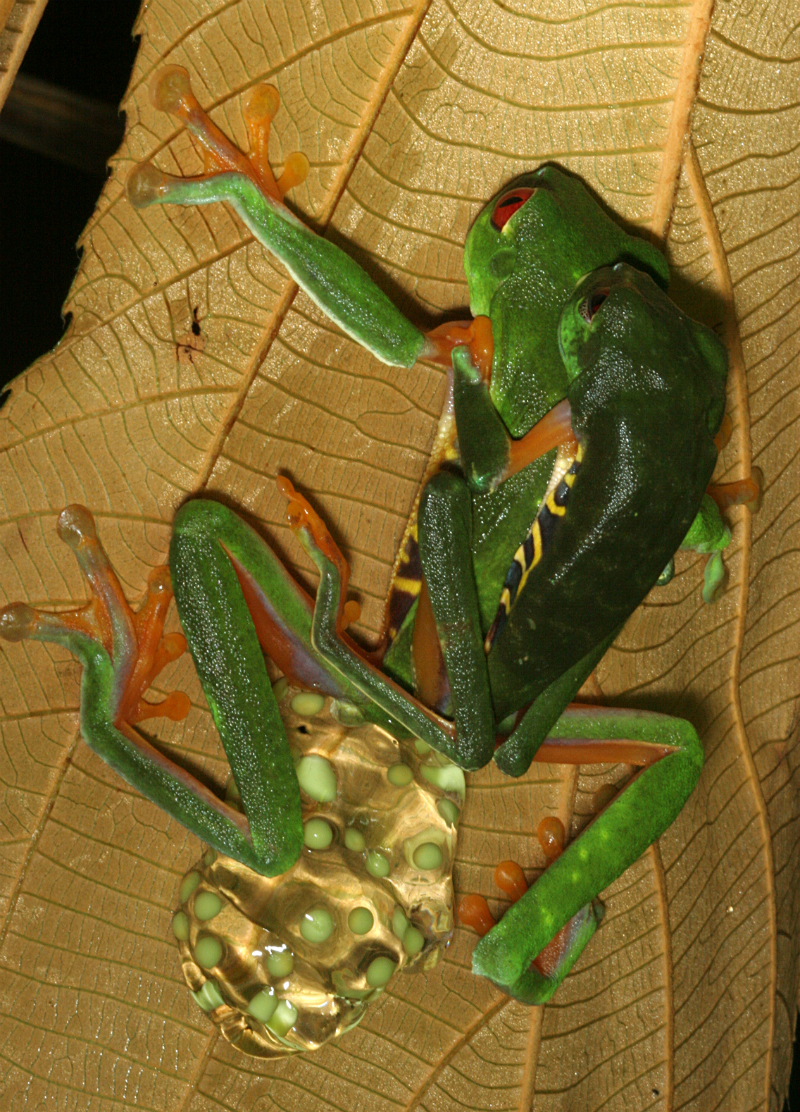
Neotropical red-eyed tree frogs lay eggs on plants over ponds, into which tadpoles fall after hatching.
A trick up their snouts
Mostfrog embryosrelease enzymes throughout their growth inside the testis , so that the tissue layer is gradually weakened over time , according to analyse co - writer Kristina Cohen , a graduate pupil at Boston University who is studying ecology , behaviour and evolution . But red - eyed Sir Herbert Beerbohm Tree toad have another trick up their sleeves — or more on the dot , their snouts .
" Red - eyedtree frog embryosstore up that enzyme , so it can all be deploy at once and at any moment , " Cohen told Live Science . The embryo ’s think up glands are on its snout , so it can direct this concentrated cat valium of chemical substance at a single aim , quickly opening an outflow hatch and make a swift lam .
How swift ? During actual flak from predatory animal , the researchers saw embryo hatch in less than 6 seconds , Warkentin say in a financial statement .

And their strategy is quite successful , Cohen add .
" After the fourth daylight of development , they can hatch rapidly , and they had about an 80 percentage success rate escape from snake in the grass , " Cohen told Live Science . It was n’t just snakes that the embryo could sense — Cohen explicate that they observed similar evasive maneuvers in response to wasps , pathogenic fungus and flooding .
Their discovery tramp embryos in a whole young light , Cohen note , revealing them to be subject of far morecomplex behaviorthan once think .

" We think of grownup animals as doing interesting thing , but embryos are realise as very passive — just waitress to hatch , " Cohen said . " I think that this research will increase cognisance of how they answer to their environment in adaptative ways . "
The finding were publish online June 15 in theJournal of Experimental Biology .
Original article onLive Science .


