When you purchase through links on our situation , we may make an affiliate charge . Here ’s how it works .
The Earth’s surface of Mars is dotted with millions of tiny , globular crystals averaging about a tenth of an inch ( 2.5 mm ) in diameter . Even though these teensy spherules help give the Red Planet its rusty color , their seemingly blue appearance in a false - colorNASA imagefrom 2004 has earned them the soubriquet " blueberries . "
heroic cosmonaut try out to juice these " berries " will be disappointed to see that they are actually hematite — mineral compounds compose ofironandoxygen . However , a new analysis of similar minerals on Earth suggests that this may not always have been the eccentric . According to a new subject area , the blueberry stones of Mars may really be hydrohematite — Fe oxide mineral that also hold microscopical suggestion of ancientwater .
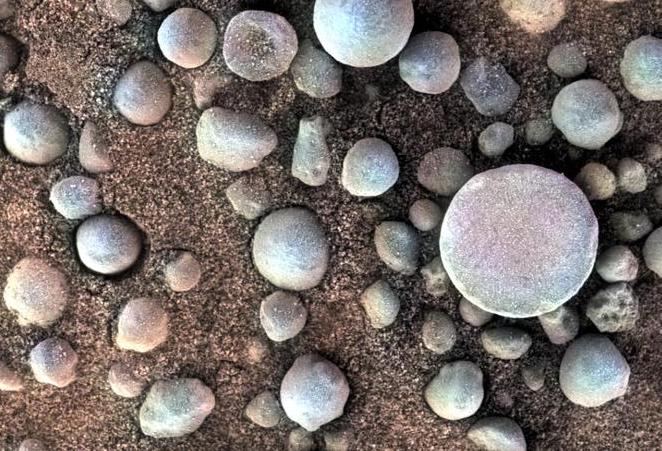
Millions of “blueberries” like these dot the surface of Mars. They could hold an important trace of ancient water, a new study suggests.
If that ’s the case , then the blueberry fields of Mars sum up up to a " substantial water reservoir , " the researchers write , offer further evidence that the Red Planet was oncewet and blue .
" Much of Mars ' surface patently originated when the Earth’s surface was wetter and iron oxides [ like the blueberries ] precipitated from that water , " survey co - generator Peter Heaney , a professor of geosciences at Penn State University , suppose in a statement . " But the existence of hydrohematite on Mars is still speculative . "
Related : Mars may hide ocean of water beneath its incrustation , study get hold
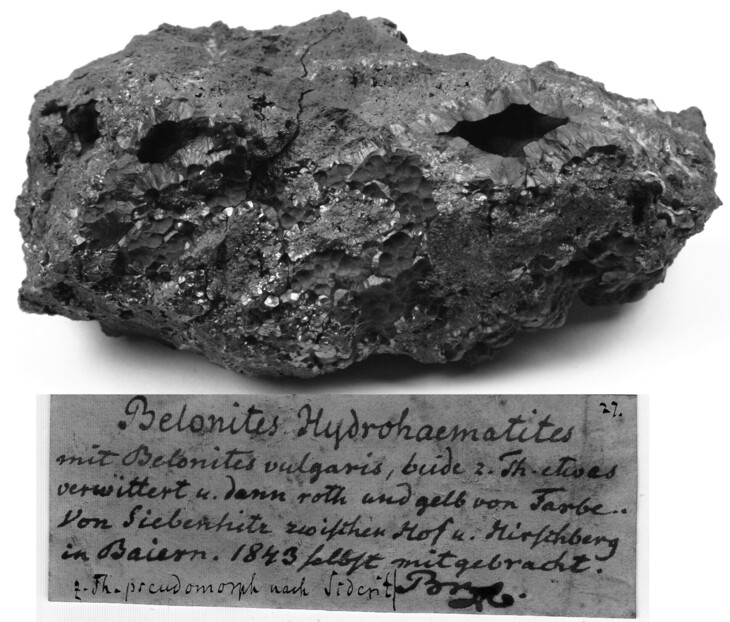
A specimen of hydrohematite discovered by German mineralogist August Breithaupt in 1843, which was analyzed in the new study.
Inside the blueberries
In their new subject field , Heaney and his colleagues examine a potpourri of hydrohematite samples from the mineral collections at the Smithsonian Institution and Penn State . The squad studied the composition of the mineral using various technique , includingX - rayandinfraredscans , and confirm that the mineral had some of their ironatomsreplaced with hydroxyl — ahydrogenand oxygen group that comes from stored water .
Next , the team need to discover the term under which hydrohematite forms , and see if it equate up to the likely condition that might have once existed on Mars . After subjecting samples to a potpourri of temperature , acidity and water system condition , the team take that hydrohematite illuminate in washy , acidulous environment at temperature low than 300 degrees Fahrenheit ( 150 degree Celsius ) .
In other speech , hydrohematite crystals could have possibly imprint out of the weak condition of ancient Mars , forming a sedimentary layer of tiny atomic number 26 pebble all across the major planet . Thus , each of the jolty , red " blueberries " on Mars may contain as much as 8 % weewee by weight .

" On Earth , these spheric structure are hydrohematite , so it seems fair to me to conjecture that the smart red pebbles on Mars are hydrohematite , " Heaney said .
— The 10 strangest places where life is discover on Earth
— The 7 most Mars - alike places on Earth

— 9 foreign excuse for why we have n’t foregather noncitizen yet
The cardinal word here is " hypothesise . " Despite the visual similarities between hydrohematite on Earth and the Martian blueberry , there ’s no definitive grounds that the blueberry contain water system . WhenNASA ’s Opportunity rover first light upon the blueberries in 2004 , it had no way of determining whether the Stone were made of hematite or hydrohematite — and current - generation rovers likePerseverancedon’t either .
Until future mission can get pristine mineral sampling back from the Red Planet , scientist can only guess at what lurks winthin the ruby stones .

The findings were published July 20 in the journalGeology ,
Originally published on Live Science .


